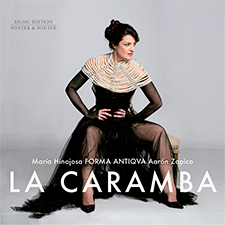
Booklet
“María Antonia Vallejo Fernández…
thirty-six years old, married to Agustín Sauminque. She lived on Calle del Amor de Dios. She received the seven sacraments of the Catholic Church and died on the tenth of June, seventeen eighty-seven. She wrote her last will and testament before Félix Tadeo Serrano on the seventh of May of the same year. She declares that she prayed at mass twenty times, giving four pennies as alms. Her mother, María Manuela Fernández, who lives at number ten Calle del Amor de Dios, and Manuel Martínez, who lives at number nine Calle del Niño, are appointed as executors of her will. She named her mother, María Manuela Fernández, as her heir. And she was publicly buried in this parish church, at the chapel of the Congregación de Nuestra Señora de la Novena, having been a member of it.”
This was how lieutenant colonel Juan Antonio de Irusta spoke of the burial of María Antonia Vallejo, also known as “La Caramba”.
Born in Motril, in Granada province, in 1751, the daughter of Bernardo Vallejo and María Manuela Fernández, as mentioned above. At seventeen she left home and went to live in Cádiz with a distant relative, providing her the opportunity to come into close contact with the vibrant life of the city. It was there that she met the businessman Manuel Martínez, who helped propel her career by presenting her to the Madrid theatrical scene. In 1776, the young singer moved to the capital during a period which would become the focal point of her short but bright career.
It is likely that the artist’s alias was taken from the exclamation “¡caramba, caramba!”, found in a tonadilla (a short, satirical song popular in 18th-century Spain) credited to Pablo Esteve Manuel Martínez (1730–1794), while she was also referenced in countless other musical works, with many compositions written with her in mind and often dedicated to her. “Caramba” would also be used to refer to the flamboyant topknot that María Antonia used to decorate her head, which would become a symbol of women’s fashion at that time.
Her daring performances, flashy public exhibitions, scandalous love life and short, sham marriage to the wealthy Agustín Sauminque y Bedó would all culminate in a mysterious episode which prompted the singer to leave this life behind: a sermon from the Capuchin friar Diego José de Cádiz pushed her towards an introverted existence. As a result, in 1785 she retired from the stage, instead opting for a life of prayer and penance. The poem entitled Verdadero arrepentimiento que hizo una muger natural de la ciudad de Motril, llamada Maria Antonia Hernandez y Vallejo (“The True Repentance of a Women from Motril Called María Antonia Hernández”), published at an unknown date in Málaga and written by Félix de Casas y Martínez, shed some light on this intimate act of contrition from a woman previously known for her promiscuity: “Until now submerged / in obscene filth / I have lived, from now on / I will not be who I once was. […] You left behind the promenades, / the music and joy: put an end to the parties / and the nights of fun.”
María Antonia would pass away just two years later, on the 10th of June 1787. Three years after, Francisco Javier de Villanueva would publish an epitaph in verse dedicated to the “penance and good death” of the artist.
“Chorizos”, “polacos” and “panduros”
Madrid’s intense theatrical scene at the end of the 18th century – brilliantly caricatured a hundred years later by Francisco Asenjo Barbieri in his zarzuela (Spanish musical theatre) play Chorizos y polacos – was centred around a handful of hives of poetic and operatic activity, including Teatro Príncipe, Teatro de la Cruz and Teatro de los Caños del Peral. These three hubs divided theatre fans into three groups, known as “chorizos”, “polacos” and “panduros”, respectively.
Upon her arrival at the city in 1776, María Antonia joined the theatre company set up by businessman Manuel Martínez, which at that time put on shows in Teatro de la Cruz. However, during the following seasons she would alternate these performances with others in Teatro del Príncipe. Her male co-star was Miguel Garrido (1745–1807), who was known as the “Prince of the Comics”. Many were the renowned authors who composed works specially for this pair, such as Blas de Laserna, José Castel, Antonio Rosales, Fernando Ferandiere and Pablo Esteve, who we talked about earlier.
In a way, the decline of “La Caramba” runs parallel to the evolution of the musical genre that catapulted her to fame. Around 1750, tonadillas originally served a similar purpose to the sainete and entremés theatrical styles: merely that of entertaining the audience during intervals in plays. However, the audience soon elevated them and they took on their own, independent style during the 1770s and 1780s. The genre began to bear a more complex nature in terms of performance, which is what also brought about its end in the 19th century.
In the case of the tonadillas featured here in this work, we are still talking about the style at its apex, its finest representation: a popular song in the strophic form which combines melodic rhythms and turns derived from folklore. Following a short, initial instrumental section, the central part of the tonadilla comprised a middle section of coplas (four-line verses), concluding with triple-time seguidillas. The metre would change frequently throughout the piece, serving two purposes: it helped place the focus on the piece’s internal structure while also maintaining the rhythm of the dance and naturally accentuating the verse.
“Usted quiere… ¡caramba, caramba!”
The frequent references to La Caramba in the music of her contemporaries and in the commemorative writings and prints released following her death in 1787 are living proof of the fervour that the artist instilled in those around her.
The comic and erotic nature of the texts that accompanied these tonadillas – very similar in nature to popular music nowadays, in fact – played on her spontaneous mischievousness to earn the applause of the audience, who are said to have continued cheering her name as they wandered through the streets of the capital city. The dotted rhythms, joyful embellishments such as appoggiaturas and mordents, and swaying melodic movements all converge to create a musical characterisation of the role of the protagonist, and they combine with movements from popular dance that would, of course, be integrated into the performances.
Seemingly forgotten for many years, interest in La Caramba piqued at the end of the 19th century, perhaps more so because of her extraordinary personal evolution than her artistic contribution to the Spanish lyric genre. The general press also wished to use the singer’s life as a stellar example of conversion to Catholicism. In this vein, the Heraldo de Madrid newspaper summed up her popularity in 1933, saying, “it wasn't just that her art was superior to that of her contemporaries, but it was her Andalusian wittiness, her poise and flamenco style in her dance and on the stage, and, most of all, her boldness and her life of promiscuity and flashiness that granted her this reputation and aura among the public.”
With its rereading of this repertoire, Forma Antiqva takes us on a journey back in time to 18th-century Madrid, where we get to witness first-hand the performances, promenades and gestures of the true star of this record: María Antonia Vallejo Fernández, La Caramba. Meanwhile, the remastering of this repertoire grants the music a more contemporary identity, releasing it into the modern world and bringing to the fore a conversation about this woman – an artist in a not-so-distant Spain – and her historic contribution to our musical heritage.
Nieves Pascual León
Recordings
Canciones, Fandangos, Saltones, Xiringosas, Giraldillas y otros brincos del Norte
Splendor in the cathedral of Oviedo
Symphonies. Madrid, 1753
Forma Antiqva plays Spanish Baroque Dance Music
Ernst Reijseger | FORMA ANTIQVA | Aarón Zapico
Chamber duets by Agostino Steffani for soprano and countertenor
Opera music from Monteverdi to Mozart arranged as instrumentals by Aarón Zapico, Daniel Zapico and Pablo Zapico
Il Cimento dell’Armonia e dell’Inventione
The Contest between Harmony and Invention
Forma Antiqva plays Baroque Dance Music
Cantatas for alto and instrumental works by Georg Friedrich Händel
Cantatas for soprano solo and continuo by Domenico Scarlatti
[out of stock]
Villancicos, saynetes, cantadas... y una batalla
Italian music of the seicento

Live concert DVD recording