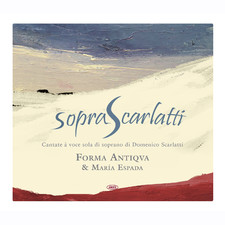
Booklet
The fact that Domenico Scarlatti was probably the most extraordinary harpsichordist in history and, more importantly, also the author of an exceptional—both in scope and quality—musical corpus dedicated to the keyboard and comprising over five hundred sonatas, has certainly not favored the dissemination of the rest of his vast creative output.
Many factors have contributed to the obscurity into which the legacy apart from the instrumental universe produced by the prolific Neapolitan musician had been plunged until very recently: scarce biographical references, confusion in attributions, abundant doubts regarding the exact chronology and composition date of a large part of his work, the disappearance of many of his autograph scores—especially those corresponding to his abundant operatic catalogue born during the early years of his career on Italian soil… Indeed, Scarlatti's rightful celebrity as the author of a keyboard oeuvre of colossal dimensions—to which he exclusively owes his fame, unlike his contemporaries Rameau, Bach, or Handel—composed fundamentally during the second half of his life spent in the Iberian Peninsula, has irremediably eclipsed a facet of Scarlattian art—the one dedicated to the voice—that is by no means negligible and to which he dedicated a good part of his talent and efforts as a composer.
It is more than probable that the marginalization that musicologists and performers have shown toward this part of his catalogue for decades stems from its status as youthful work, composed when the musician's career was following somewhat conventional paths and still subjected to an enormous paternal influence; for it must be remembered that Alessandro Scarlatti (1660-1725), who was chiefly responsible for his solid musical education, was one of the most renowned vocal composers of his time. It seems logical, therefore, that Domenico's vocal work followed the stylistic paths and formal models of his famous progenitor.
The successive positions that the young Scarlatti held in his homeland (organist and composer of the Royal Chapel of Naples in 1701, where Alessandro was master; chapelmaster to the exiled Queen of Poland, Marie Casimire, in Rome until 1714; and the homonymous post at the prestigious Vatican Cappella Giulia from that date) until his move to Lisbon at the end of 1719—where he was in charge of the musical education of the king's brother, Infante Dom António of Braganza, and especially of Princess Maria Barbara, the monarch's daughter and Queen of Spain from 1746 as the wife of King Ferdinand VI—made possible the composition of numerous vocal scores of all genres. These ranged from opera—Tolomeo e Alessandro (1711), Ifigenia in Aulide (1713), Berenice, regina d’Egitto (1718)—to numerous oratorios and cantatas on religious subjects—La conversione di Clodoveo, re di Francia (1709), Applauso devoto al nome di Maria Santissima (1712)—to which are added quite a few serenatas, pastorales, and other commemorative pieces for the festivities and celebrations of the lavish Lisbon court of King John V.
Even so, the vocal genre cultivated in the greatest number by Scarlatti—more than half a hundred pieces are preserved—is the chamber cantata. The intimate dimensions of these compositions for voice and a small instrumental ensemble (violone, theorbo, archlute, guitar, harpsichord...), distributed in one or two arias preceded by their corresponding recitatives, nevertheless allow the musician to experiment with the dramatic possibilities of secular texts. Belonging mostly to the subgenre of the lettere amorose, these texts speak to us of the torments of the experience of love: unrequited feelings, jealousy, uneasiness, unhappiness, abandonment, and revenge.
Here, Scarlatti's genius abandons the exclusive, acrobatic virtuosity practiced by so many of his contemporaries to lean toward a style of writing that, while not without difficulties for the singer, emphasizes expressive nuances, the depiction of the affetti (emotions), and ingenious ornamental execution, without disdaining certain archaizing features that are likewise present in many of his most successful religious productions. The luminous melodic lyricism of the Neapolitan shines in pages such as the aria “A te sol, Bella, dimando” from the cantata No, non fuggire o Nice; the nostalgic languor of “Ha il tuo volto un non sò che,” belonging to Tu mi chiedi o mio ben; and “Allor ti pentirai,” which seem to harken back to analogous passages by the early Handel—with whom Scarlatti competed in one of the musical evenings organized in Rome by Cardinal Ottoboni—; the atmosphere close to Neapolitan opera buffa exuded by “O se ride o se favella”; or the lighthearted tone, infused with popular turns of phrase—those which would later bring luster to his most original keyboard sonatas—that can be appreciated in the aria “Se parla il core, bell’Idol mio.”
Juan Manuel Viana
Recordings
Canciones, Fandangos, Saltones, Xiringosas, Giraldillas y otros brincos del Norte
The most extroverted character of the Spanish 'tonadilla' in the 18th century.
Splendor in the cathedral of Oviedo
Symphonies. Madrid, 1753
Forma Antiqva plays Spanish Baroque Dance Music
Ernst Reijseger | FORMA ANTIQVA | Aarón Zapico
Chamber duets by Agostino Steffani for soprano and countertenor
Opera music from Monteverdi to Mozart arranged as instrumentals by Aarón Zapico, Daniel Zapico and Pablo Zapico
Il Cimento dell’Armonia e dell’Inventione
The Contest between Harmony and Invention
Forma Antiqva plays Baroque Dance Music
Cantatas for alto and instrumental works by Georg Friedrich Händel
Villancicos, saynetes, cantadas... y una batalla
Italian music of the seicento
Live concert DVD recording